

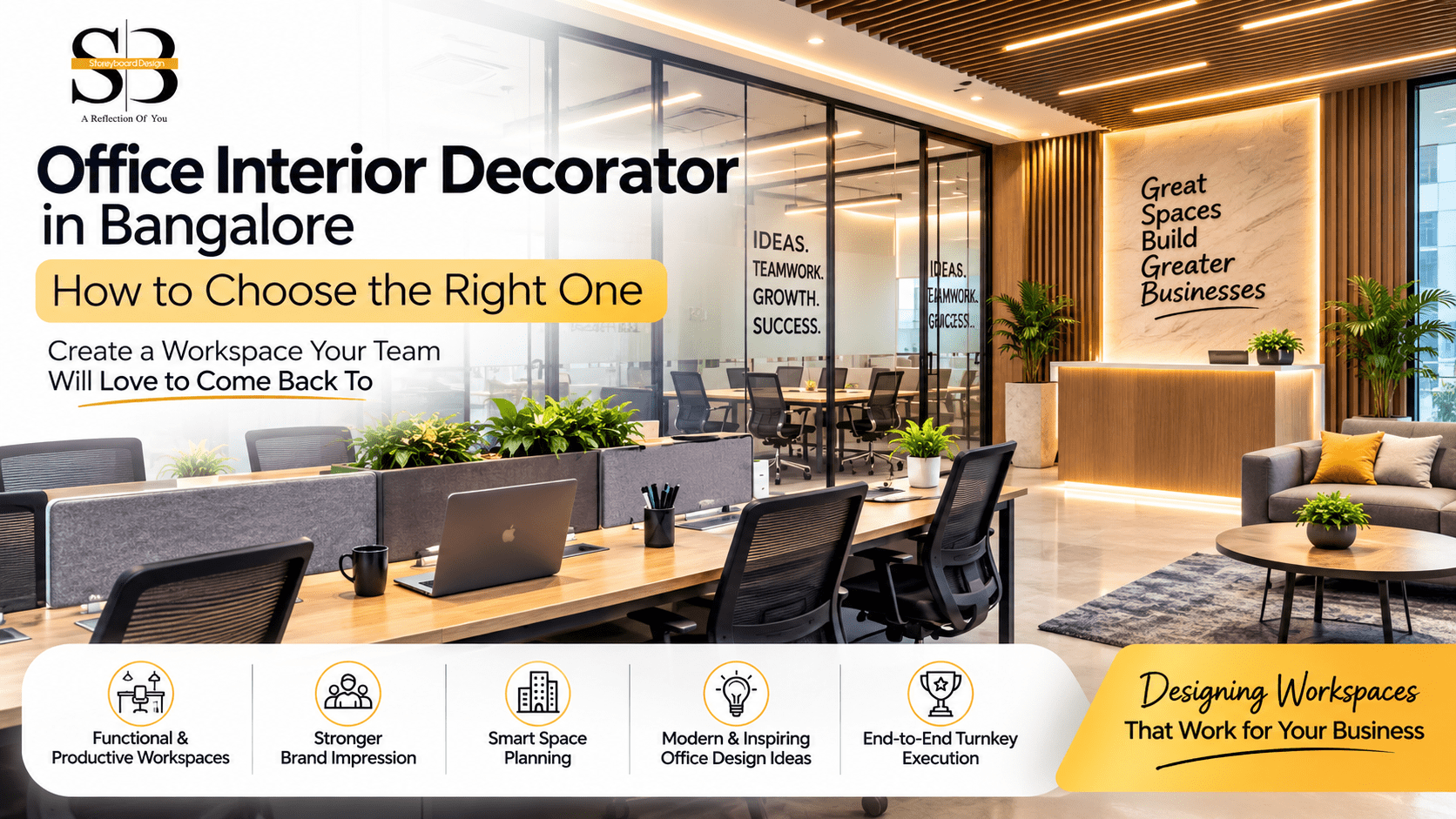
Office Interior Decorator: How to Choose the Right One for a Modern Office in Bengaluru
Your office is more than a place where people sit, open laptops, attend meetings, and leave at the end of the day. It is where ideas are exchanged, teams grow, clients form their first impressions, and your brand quietly communicates what it stands for. That is why choosing the right office interior decorator can make a surprisingly big difference.
A poorly planned office can feel cramped even when there is enough space. Employees may struggle with uncomfortable seating, insufficient storage, poor lighting, or distracting layouts. Moreover, business owners often face another frustrating problem: the beautiful 3D design shown at the beginning does not always look the same when the project is finally completed.
Finding the right professional is therefore not simply about choosing someone who can make an office look attractive. It is about finding a team that understands functionality, timelines, budgets, employee comfort, brand identity, and execution. Whether you are setting up a compact startup office or creating a premium corporate workspace, the right approach can turn an ordinary floor plan into a productive and impressive workplace.
What Does an Office Interior Decorator Actually Do?
An office interior decorator helps transform a workplace into a functional and visually appealing environment. However, the role can go much further when the decorator works as part of a complete interior design and execution team.
A professional team may help with:
- Space planning
- Workstation layouts
- Reception design
- Cabin and meeting-room planning
- Lighting selection
- Wall finishes
- Flooring and ceiling concepts
- Storage solutions
- Furniture selection
- Branding elements
- Material selection
- Colour schemes
- Décor and accessories
- Electrical and lighting coordination
- Final installation and styling
Furthermore, modern office interiors need to balance appearance with everyday usability. A stunning reception area means little if employees do not have comfortable workstations or if meeting rooms lack adequate privacy.
That is why you should look beyond photographs when selecting an office design professional.
Why Choosing the Right Office Interior Decorator Matters
To illustrate, imagine two companies occupying almost identical 2,000-square-foot spaces.
The first office has poor circulation, dark corners, limited storage, uncomfortable furniture, and no clear separation between collaborative and focused work.
The second uses the same approximate area but has well-planned workstations, natural light, meeting zones, storage, breakout spaces, and a welcoming reception.
The difference is not necessarily the size of the office. It is the planning.
A good workplace design can help address several common challenges:
Better Use of Available Space
Every square foot costs money. Therefore, an efficient layout should make the space work harder without making it feel crowded.
Improved Employee Comfort
Moreover, employees spend a significant portion of their day at work. Comfortable seating, appropriate lighting, sensible desk spacing, and good circulation can create a better daily experience.
Stronger First Impressions
Additionally, your reception area is often the first physical interaction a client has with your business. Moreover, the office environment can communicate professionalism before your team says a word.
Better Brand Expression
Colours, materials, graphics, furniture, lighting, and architectural details can subtly reflect your brand personality.
Easier Future Expansion
A thoughtful office interior can also accommodate changing team sizes and evolving business requirements.
Office Interior Design Problems Businesses Commonly Face
Hiring an office interior decorator should solve problems, not create new ones. Unfortunately, many commercial interior projects run into predictable difficulties.
1. The Project Takes Longer Than Expected
A business may plan to move into its new office on a specific date. However, delays in carpentry, electrical work, material procurement, painting, or furniture installation can push the schedule further.
As a result, the company may continue paying for its existing workplace while waiting for the new one.
2. The Budget Keeps Increasing
An initial quote may look attractive, but additional requirements sometimes appear during execution.
For example:
- Additional electrical points
- Upgraded materials
- Extra storage
- Design changes
- Custom furniture
- Additional lighting
- Last-minute décor requirements
Therefore, it is important to understand exactly what is included in the initial scope.
3. The Final Office Looks Different From the Design
This is one of the biggest concerns clients have.
A 3D render can look exceptional. Yet, if the materials, dimensions, lighting, colours, or detailing are not executed accurately, the finished office may feel completely different.
Consequently, the design-to-execution process matters just as much as the initial concept.
4. Too Many Vendors
Imagine coordinating with a carpenter, electrician, painter, flooring contractor, furniture supplier, ceiling contractor, designer, and décor vendor.
It quickly becomes exhausting.
Moreover, when something goes wrong, every vendor may point toward another person.
A turnkey approach can reduce this coordination burden by putting design, sourcing, and execution under one management structure.
How to Choose the Best Office Interior Decorator in Bangalore
Searching online for “office interior decorator near me” can give you dozens of results. The difficult part is deciding which one deserves your project.
Instead of choosing only based on price, consider these factors.
Check Their Commercial Interior Portfolio
Residential and office interiors require different thinking.
Look for completed projects involving:
- Corporate offices
- Startup offices
- Retail spaces
- Clinics
- Showrooms
- Hospitality spaces
- Premium commercial environments
A portfolio gives you an idea of whether the team can handle the type and scale of project you have in mind.
Ask How They Handle Execution
A beautiful design is only the beginning.
Ask:
- Who manages the site?
- Who coordinates contractors?
- How frequently will progress be reviewed?
- Who approves materials?
- How are changes handled?
- What happens if there is a delay?
Furthermore, ask to see actual completed projects rather than relying exclusively on 3D renders.
Understand the Cost Before Work Begins
A professional proposal should clearly explain what you are paying for.
A useful estimate can include:
| Project Element | What You Should Check |
|---|---|
| Design | Layouts, 3D views, revisions and drawings |
| Civil Work | Partitions, flooring and structural modifications |
| Electrical | Wiring, switches, sockets and lighting points |
| Ceiling | Material, design and installation |
| Furniture | Workstations, cabins, storage and seating |
| Finishes | Paint, laminates, wallpapers and surface treatments |
| Décor | Accessories, artwork, plants and styling |
| Project Management | Site supervision and coordination |
| Installation | Labour, transportation and fitting |
Therefore, don’t compare two quotations only by their final numbers. Compare what each quotation actually contains.
Small Office Interior Designers in Bangalore: What Changes?
A small office does not mean you need fewer design ideas. It means every decision needs to be more strategic.
When space is limited, an experienced office interior decorator can use design techniques to create a more spacious feeling.
Use Flexible Furniture
Modular desks and movable furniture can allow the same space to serve multiple purposes.
For example, a meeting table can sometimes double as a collaborative workspace.
Use Vertical Storage
Instead of consuming valuable floor space, tall storage units can take advantage of vertical walls.
Create Visual Openness
Glass partitions, lighter finishes, consistent flooring, and appropriate lighting can make compact offices feel larger.
Avoid Overdecorating
Too many colours, furniture pieces, wall accessories, or bulky partitions can make a small office feel congested.
Therefore, minimalism can be especially useful in compact workplaces.
Office Interior Ideas That Work for Modern Businesses
There is no single office design that works for every company. Your workplace should reflect how your team actually works.
Open Collaborative Areas
Open areas can encourage informal discussions and teamwork. However, they should not replace every private space.
Private Meeting Rooms
Small meeting rooms are useful for confidential discussions, interviews, online meetings, and focused conversations.
Comfortable Breakout Zones
A thoughtfully designed breakout area can provide employees with a place to relax, have informal conversations, or step away from their desks.
Brand-Focused Reception Areas
The reception should communicate your brand without becoming excessively decorative.
A combination of signage, lighting, furniture, textures, and carefully selected colours can create a strong first impression.
Smart Lighting
Lighting has a major influence on how a workplace feels.
Use a combination of ambient, task, accent, and decorative lighting where appropriate. Furthermore, make use of natural light whenever possible.
Design Should Follow How Your Team Works
Before hiring an office interior decorator, observe how your employees actually use the workplace.
Ask yourself:
- Do teams collaborate frequently?
- Do employees need quiet focus areas?
- Are client meetings common?
- Do managers require private cabins?
- Is hybrid work part of your routine?
- How much storage is required?
- Does the business expect to grow soon?
For example, a creative agency may benefit from collaborative zones and informal meeting areas. Conversely, a legal or financial firm may require more private rooms and sound-controlled spaces.
Therefore, good office design starts with understanding the business rather than selecting furniture first.
Why 3D Visualization Can Make the Process Easier
One of the biggest advantages of modern interior design technology is the ability to visualise a space before execution.
Instead of imagining what a material combination might look like, clients can review a detailed 3D concept.
This can help answer questions such as:
- Does the reception feel too dark?
- Is the conference table too large?
- Are the colours suitable?
- Does the workstation arrangement leave enough circulation?
- Does the storage design look bulky?
- Will the lighting create the desired atmosphere?
Moreover, faster design iterations can help businesses make decisions earlier.
Storeyboard Design uses 3D technology as part of its design process, including rapid model development, helping clients visualise their proposed spaces before moving deeper into execution.
From Design to Reality: Why Execution Matters
A great office is not created by a render alone.
The actual result depends on measurements, materials, workmanship, installation, lighting, finishing, and site supervision.
This is where an end-to-end interior design and turnkey execution approach can become valuable.
Instead of asking the client to coordinate several independent vendors, one team can manage:
- Initial consultation
- Site measurement
- Space planning
- Concept development
- 3D visualisation
- Material selection
- Cost estimation
- Procurement
- Site execution
- Quality checks
- Installation
- Final styling
As a result, the client has fewer moving parts to manage.
What Makes Storeyboard Design Different?
Storeyboard Design approaches interiors as a combination of design, technology, execution, and experience.
The company works across residential and commercial spaces and focuses on taking projects from concept through execution.
For clients who want to understand materials before making decisions, Storeyboard Design also has a 40,000-square-foot experience centre where different interior products, finishes, and design possibilities can be explored.
Furthermore, the company focuses on rapid 3D model delivery, personalised design concepts, and turnkey execution.
The idea is simple: the client should not have to become a full-time project manager just to complete an interior project.
See Interior Projects Before Making Your Decision
Before choosing your office interior decorator, spend some time looking at real projects.
You can explore Storeyboard Design’s project videos and understand how design ideas translate into finished spaces.
For example, the Interior Design by SBD project provides a useful visual reference for understanding the design approach.
You can also explore another Storeyboard Design project video to see more examples of completed interior work.
For a look at contemporary residential execution, Experience Storeyboard Design’s bold and modern 4BHK interiors shows how a detailed concept can be translated into a finished home.
The Insta-Worthy Home for an Influencer is another example of a project where design, styling, and execution come together.
You can also explore this additional Storeyboard Design project for more inspiration.
If you are researching premium commercial or retail interiors, looking at projects such as Khea Jewellers Bangalore can also help you understand how brand identity can influence interior design decisions.
Questions to Ask Before Hiring an Office Interior Decorator
Before signing a contract, ask direct questions.
About Design
- How many design revisions are included?
- Will I receive detailed 3D views?
- Can I select materials?
- How will you match the final execution with the design?
About Budget
- Is the quotation itemised?
- What is excluded?
- Are transportation and installation included?
- How are changes charged?
About Timeline
- What is the estimated completion date?
- Who manages the site?
- How will delays be handled?
- What happens if materials are unavailable?
About Execution
- Who coordinates the contractors?
- Is there a dedicated project manager?
- How are quality checks performed?
- What warranty or post-handover support is provided?
The more specific the answers, the easier it becomes to compare different interior companies fairly.
Office Interior Decorator vs. Multiple Independent Contractors
You may be wondering whether hiring separate contractors could reduce the project cost.
Sometimes it can appear cheaper initially. However, you also take on the responsibility of coordination.
| Turnkey Interior Team | Multiple Independent Vendors |
|---|---|
| One primary point of contact | Multiple points of contact |
| Centralised project management | Client manages coordination |
| Unified design and execution | Design may not match execution |
| Easier material coordination | Client tracks multiple suppliers |
| Integrated planning | Higher risk of communication gaps |
| More structured workflow | Scheduling can become complicated |
Therefore, the cheapest quote is not always the lowest-cost solution once time, coordination, mistakes, and delays are considered.
A Simple Checklist Before You Start
Before approaching an office interior decorator, prepare these details:
- Office size
- Number of employees
- Number of cabins required
- Meeting-room requirements
- Storage needs
- Reception requirements
- Approximate budget
- Expected completion date
- Brand colours
- Preferred design style
- Future expansion plans
This preparation can make the first consultation much more productive.
Moreover, it allows the designer to understand your priorities instead of starting with assumptions.
Final Thoughts
Choosing an office interior decorator is ultimately about much more than creating attractive walls, furniture, and lighting. The right professional should understand how your business works and translate that understanding into a workplace that feels practical, comfortable, impressive, and aligned with your brand.
Start by examining real commercial portfolios, understanding the scope of work, comparing detailed quotations, and asking how design will be translated into actual execution. Furthermore, pay close attention to timelines, material quality, project management, and communication.
Whether you are planning a compact startup office, a growing corporate workspace, or a premium commercial environment, thoughtful planning can prevent many common interior mistakes.
A well-designed office should not simply look good on the day of handover. It should continue working for your business long after the project is complete.
Frequently Asked Questions
1. How can an office interior decorator in Bangalore transform my workspace into a modern, productive environment?
An office interior decorator can improve space planning, lighting, furniture, branding, storage, and workplace flow to create a functional and inspiring office.
2. What should I check before hiring an office interior decorator in Bangalore for my business?
Check their commercial portfolio, reviews, pricing transparency, execution process, project timeline, material quality, 3D designs, and post-handover support.
3. How much does an office interior decorator in Bangalore typically charge for complete office interiors?
Costs depend on office size, materials, furniture, finishes, design complexity, and execution requirements. Request an itemized quotation before starting.
4. Why should businesses hire an office interior decorator instead of managing multiple contractors themselves?
An office interior decorator can coordinate design, materials, contractors, and execution through one team, reducing communication problems and project-management stress.
5. Can an office interior decorator help maximize space in a small Bangalore office effectively?
Yes. They can use smart layouts, multifunctional furniture, vertical storage, glass partitions, and suitable lighting to make smaller offices feel spacious.
6. How long does an office interior decorator usually take to complete a commercial interior project?
The timeline depends on project size and scope. A professional team should provide a realistic schedule covering design, procurement, execution, and installation.
7. What mistakes should I avoid when choosing an office interior decorator for my Bangalore office?
Avoid choosing solely based on the lowest price. Also check portfolios, hidden costs, timelines, material specifications, workmanship, communication, and execution capabilities.
8. Can an office interior decorator provide 3D designs before starting the actual office project?
Yes. Many professional designers provide 3D visualizations that help clients understand layouts, materials, colours, furniture, lighting, and the expected final appearance.
9. How does an office interior decorator ensure the finished office matches the approved design perfectly?
Accurate measurements, material approvals, detailed drawings, site supervision, quality checks, and consistent coordination between designers and execution teams help maintain design accuracy.
10. What makes the best office interior decorator different from ordinary commercial interior design companies?
The best teams combine creative design, practical space planning, transparent pricing, quality materials, experienced execution, technology, project management, and reliable communication.

Leave a Reply