

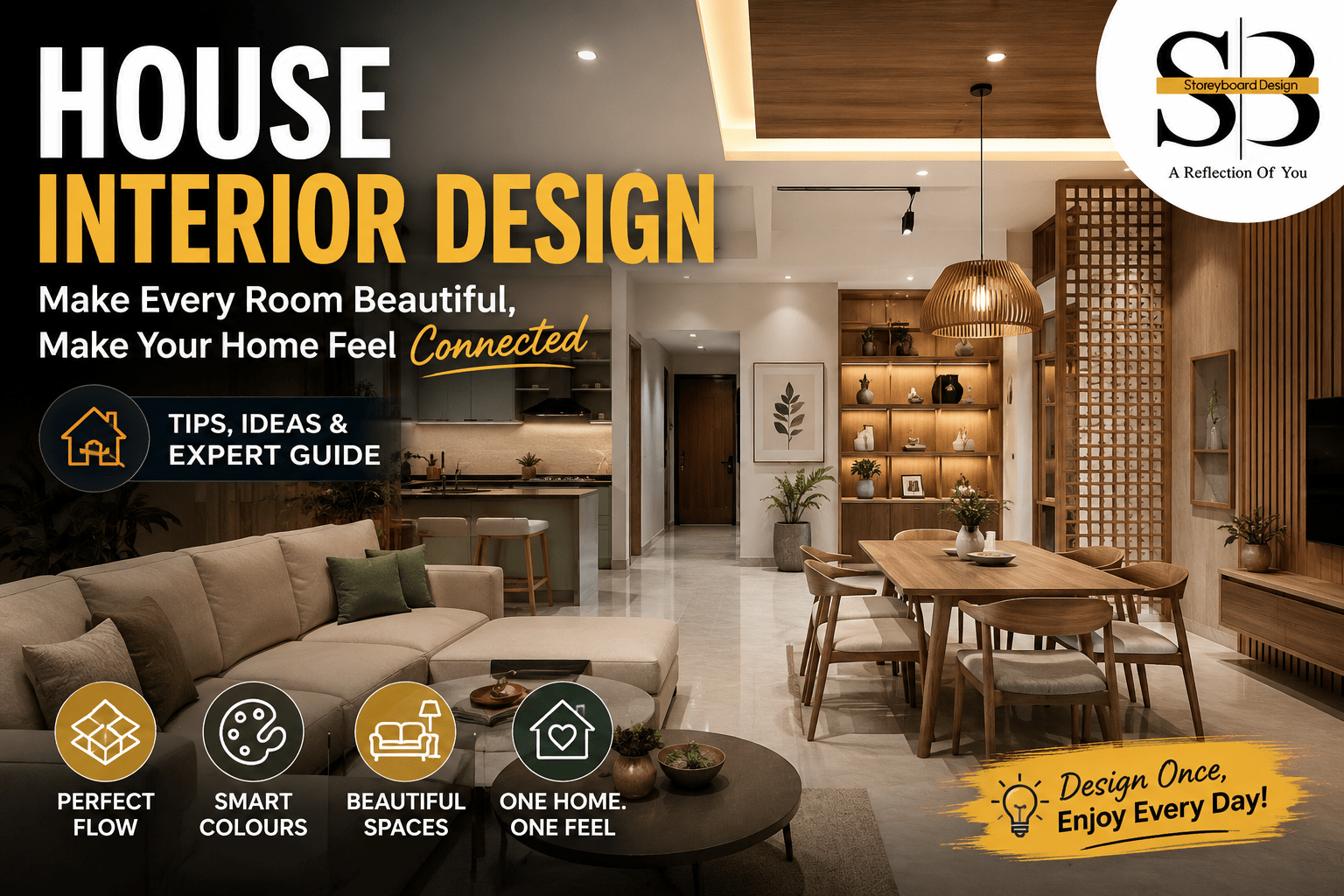
House Interior Design: How to Make Your Whole Home Feel Connected
Have you ever spent a lot of money designing your home, only to feel that something still looks wrong? 😕
Your living room may look beautiful. The kitchen feels modern. Your bedroom may feel warm and comfortable. However, when you walk from one room to another, the whole house can suddenly feel disconnected.
And honestly, that can be frustrating.
You may love every room individually, yet the home does not feel like one complete home.
The good news is that you do not need to make every room look exactly the same. Instead, good house interior design is about creating a visual connection between different spaces.
Therefore, you can give every room its own personality while still making the entire home feel balanced, comfortable, and thoughtfully designed. ✨
In this guide, we will look at simple ways to create better flow, choose common materials, connect different rooms, control colours, and avoid expensive interior design mistakes.
What Makes House Interior Design Feel Disconnected?
Before fixing the problem, you need to understand why it happens.
Many homeowners design their homes one room at a time. At first, this seems like a good idea because every room has a different purpose.
However, problems often appear when you start walking from one space to another.
For example:
- The living room may have warm wooden flooring.
- The kitchen may suddenly use a completely different floor.
- The bedroom may have a dark wall colour.
- The kids’ room may use bright colours everywhere.
- The lighting temperature may change from warm to cool.
- Door handles, trims, and finishes may all look different.
Individually, these choices may look good. But together, they can make your home feel like several different houses joined together.
That is why successful house interior design should consider the entire home, not just individual rooms.
7 Signs Your House Interior Design Is Missing Visual Flow
Fortunately, there are some easy signs to identify.
1. Every Room Has a Completely Different Style
You might have a modern living room, rustic bedroom, traditional dining room, and colourful kids’ room.
There is nothing wrong with mixing styles. However, if there is no connecting element, the transition can feel uncomfortable.
2. Your Flooring Changes Everywhere
Different flooring in every room can visually break the home into separate sections.
Instead, consider using one main flooring material across important common areas whenever practical.
3. Wall Colours Change Too Dramatically
A soft beige living room followed by a bright blue hallway and dark green bedroom can create strong visual interruptions.
Therefore, choose a common colour family and then introduce stronger colours through selected accents.
4. Lighting Feels Different in Every Room
For example, one room may have warm lighting while the next has cool white lighting.
As a result, the home can feel inconsistent, especially at night.
5. Doorways Look Like Entry Points to Different Homes
This is one of the easiest things to notice.
When you stand in one room and look into another, the colours, flooring, furniture, and finishes should work together rather than compete with each other.
6. You Cannot Describe Your Home’s Overall Style
You may be able to explain every room separately.
However, if you cannot describe the overall home in a few words, your design may need a stronger connecting idea.
7. Photos Look Better Than the Actual Walkthrough
Individual room photos may look amazing.
Yet, when you walk through the complete house, something feels slightly off.
That usually means the individual spaces were designed well, but the connections between them were not planned properly.
Why Designing Every Room Separately Can Backfire
Designing each room independently feels natural.
After all, your bedroom needs to feel different from your kitchen. Similarly, a kids’ room should not necessarily look like a formal living room.
However, the problem is not having different rooms.
The problem is having different rooms with no visual relationship.
For example:
- Different flooring at every doorway can break continuity.
- Dramatically different wall colours can create visual tension.
- Different hardware finishes can make the home feel inconsistent.
- Different lighting temperatures can change the mood suddenly.
- Completely unrelated furniture styles can make the house feel unplanned.
Therefore, the goal of good house interior design is not to make everything identical.
Instead, it is to create a few repeated elements that quietly connect the spaces. 😊
Create One Continuous Base for Your Home
One of the simplest ways to improve whole-house flow is to create a consistent base.
Think of this as the foundation of your interior design.
Use Consistent Flooring Where Possible
If practical, use the same flooring material across:
- Living room
- Dining area
- Hallways
- Open-plan spaces
- Main circulation areas
Consequently, your eye sees these spaces as part of one larger home.
If you need different flooring in bedrooms or bathrooms, try to keep the transition clean and intentional.
Choose a Common Neutral Background
A warm off-white, soft beige, light greige, or stone-inspired colour can work well as a connecting background.
Then, instead of changing the entire wall colour in every room, introduce personality through furniture, fabrics, artwork, and accent walls.
This approach makes your house interior design feel calmer without making it boring.
Try the 60-20-20 Rule
Here is a simple design trick you can use when planning your home. 🏡
Think of your room in three layers.
60% — The Core
This should include the major elements that connect your home:
- Main flooring
- Primary wall colour
- Ceiling tone
- Large background surfaces
20% — The Connecting Thread
Next, repeat a few details throughout the home.
For example:
- Brushed brass hardware
- Oak finishes
- Black metal frames
- Fluted details
- Similar wood tones
- Matching door handles
You do not need to use these elements everywhere.
Instead, repeat them naturally in different rooms.
20% — The Personality
Finally, allow each room to become unique.
For example:
- A muted olive sofa in the living room
- A terracotta headboard in the bedroom
- Pastel accessories in the kids’ room
- Charcoal-blue cabinets in the home office
This way, every room feels different, yet the house still feels connected.
Check Every Doorway Before finalizing Your Design
Here is a simple trick that costs nothing. 👀
Stand at the doorway of every room.
Then look into the next space.
Ask yourself:
“Does this room feel connected to the space behind me?”
If the answer is no, check these elements.
Colour
The main colour of the next room should work with the corridor or room you are standing in.
Flooring
Try to avoid sudden flooring changes unless they are necessary.
Doors and Handles
Keeping door styles, skirting, and handles consistent can create a strong architectural connection throughout the house.
Lighting
A warm lighting temperature, generally around 2700K–3000K for comfortable residential ambience, can help create consistency across rooms.
Most importantly, check the home at night too.
A house that looks connected during the day can feel completely different when different lighting temperatures are switched on.
Plan Your House Interior Design Budget as a Whole
Your interior budget should not only be divided room by room.
Instead, think about the house as a collection of connected zones.
For example, create separate budget categories for:
- Flooring
- Wall finishes
- Doors and hardware
- Lighting
- Furniture
- Storage
- Kitchen
- Bedroom interiors
- Living room interiors
- Decorative elements
First, decide the common elements.
Then, allocate money for individual room accents.
This approach can also help you avoid unnecessary spending.
For example, if you choose your flooring and hardware early, you are less likely to change them later because another room looks different.
Before finalizing your budget, it is also worth understanding the common mistakes homeowners make when hiring interior professionals.
[Read our guide to common interior design service mistakes before you hire a designer.]
What If You Are Renovating Your Home One Room at a Time?
Not everyone can design the entire home at once.
Sometimes, you may start with the kitchen this year, the living room next year, and the bedrooms later.
That is completely fine. 👍
However, create a basic design plan before you start.
Write down:
- Paint colour codes
- Flooring details
- Wood finishes
- Hardware finish
- Door style
- Lighting temperature
- Main design style
Then, keep this information for future rooms.
As a result, even if you renovate your home over several years, the final result can still feel connected.
House Interior Design Ideas for Different Types of Homes
Every home has different needs.
Therefore, your approach should change depending on the property.
For a New Apartment
If you have just purchased a new apartment, decide your flooring, wall palette, wood finish, and hardware before designing individual rooms.
This creates a strong foundation from the beginning.
For an Independent House or Villa
If your home has multiple floors or separate wings, repeat at least one connecting element throughout the property.
For example, you could use the same wood finish or hardware across different floors.
For an Older Home
If you are modernising an existing home, start with shared areas.
Focus on:
- Hallways
- Staircases
- Living areas
- Door frames
- Common flooring
- Lighting
These areas have a major impact on how the whole house feels.
For a Rental Home
You do not need to make permanent changes.
Instead, use removable or flexible elements such as:
- Curtains
- Rugs
- Cushions
- Artwork
- Furniture
- Lighting
- Decorative accessories
That way, you can create a consistent style without major renovation.
Don’t Forget the Kitchen
The kitchen is one of the most important parts of modern house interior design.
Because it often connects directly with the dining and living areas, its colours and finishes can strongly influence the overall home.
For example, if your living room uses warm wood and neutral tones, you can continue those colours into your kitchen through cabinets, handles, counters, or open shelving.
This does not mean the kitchen needs to look identical to the living room.
Instead, a few repeated materials can create a natural connection.
For more ideas, explore our guide to [modular kitchen design ideas, layouts, and prices].
A Simple Example: Two Similar Homes
Imagine two homeowners designing similar 3BHK homes.
The first homeowner chooses everything independently.
The flooring is different in every room. The wall colours change dramatically. The hardware is mixed. The lighting also changes from room to room.
Every room looks good.
However, walking through the home feels like walking through several different showrooms.
Now consider the second homeowner.
First, they choose one main flooring style.
Next, they select a common wall palette.
Then, they repeat the same hardware finish across the house.
Finally, they add unique colours and furniture to each room.
Interestingly, both homeowners may spend a similar amount.
However, the second home feels much more complete.
Why?
Because the second homeowner designed the whole house first and the individual rooms second.
Common House Interior Design Mistakes to Avoid
Before you start your project, watch out for these mistakes. ⚠️
Mistake 1: Choosing Every Room Separately
Instead, decide your overall design direction first.
Mistake 2: Using Too Many Materials
More materials do not automatically mean better design.
Sometimes, fewer materials create a more premium appearance.
Mistake 3: Ignoring Doorway Views
A room may look beautiful from inside but completely different from the hallway.
Therefore, always check the room from different viewpoints.
Mistake 4: Changing Hardware Everywhere
Choose one or two finishes and repeat them thoughtfully.
Mistake 5: Forgetting Lighting
Good lighting can connect the home just as much as flooring and colour.
Mistake 6: Following Trends Too Closely
Trends can be exciting.
However, your home should still feel comfortable and personal several years from now.
Mistake 7: Starting Work Without a Complete Plan
A small decision made early can prevent an expensive correction later.
Need Professional Help With Your Home?
Sometimes, the hardest part is not finding beautiful ideas.
It is knowing which ideas actually work together.
That is where a professional interior designer can help.
A good designer does not simply make each room look attractive. Instead, they consider the complete journey through the home — from the entrance to the living room, kitchen, dining area, bedrooms, and other spaces.
If you are also planning a workspace, you can explore our guide on [choosing an office interior decorator near Bangalore].
And, before hiring anyone, make sure you understand the [common mistakes people make when choosing interior design services].
You can also explore professional home interior solutions and see how different spaces can be planned as one complete design.
Watch These Videos for More Interior Design Inspiration 🎥
If you prefer visual inspiration, these videos can help you explore additional interior design ideas:
- Interior design inspiration: https://www.youtube.com/watch?v=4dG-2eOgDlo
- More interior design ideas: https://www.youtube.com/watch?v=JoScxOJx9Z0
Use these as inspiration, but remember that your home’s size, layout, lifestyle, storage needs, and budget should always guide the final design.
Frequently Asked Questions About House Interior Design
1. What is house interior design?
House interior design is the process of planning colours, furniture, lighting, materials, layouts, storage, and decor for a home.
2. Should every room have the same interior style?
No. Each room can have its own personality. However, repeating colours, materials, or finishes can create better overall flow.
3. How can I make my house look more luxurious?
Start with a simple colour palette, consistent materials, good lighting, clean storage, and carefully selected furniture instead of adding too many decorative items.
4. Is the same flooring throughout the house a good idea?
It can be. Using one flooring material across connected areas can make a home feel larger and more visually continuous.
5. How many colours should I use in house interior design?
There is no fixed number, but keeping a controlled colour palette usually creates a calmer and more coordinated home.
6. Can a small 2BHK use these design principles?
Absolutely. In fact, smaller homes can benefit even more from consistent flooring, wall colours, and finishes because visual changes are easier to notice.
7. How do I connect different interior styles?
Choose one or two common elements, such as wood, metal finishes, colour tones, lighting, or flooring, and repeat them across the rooms.
8. Should I design my whole house at once?
If possible, yes. Even if you renovate one room at a time, create the overall design direction before starting.
9. Can interior designers help with the complete house?
Yes. A professional designer can help coordinate layouts, colours, materials, furniture, lighting, storage, and other elements across multiple rooms.
10. What is the biggest house interior design mistake?
One of the biggest mistakes is designing every room separately without considering how the rooms look and feel when viewed together.
Final Thoughts
Your home does not need every room to look identical.
In fact, that can make the space feel boring.
Instead, great house interior design creates a common foundation while allowing every room to have its own personality. 🏡✨
Start with one flooring direction, a simple colour palette, a few repeated materials, and consistent lighting. Then, add personality through furniture, artwork, fabrics, and accents.
Most importantly, do not only look at each room separately.
Walk through your home.
Look through the doorways.
Notice how one space leads into another.
Because ultimately, your home is not a collection of separate rooms.
It is one story, and every room should feel like the next chapter. ❤️

Leave a Reply